
Reviews
Structural Engineer Challenge turns bridge building into a logic puzzle where material properties and force distribution matter more than reflexes. The clean visuals and non-graphic collapse animations keep the tone light, making it accessible to younger players. Its main strength is the iterative feedback loop: weak points break first, so you learn exactly what to fix. The lack of a single correct solution encourages creativity, though players seeking fast action may find the pace deliberate.
About this game
Building Under Real Constraints
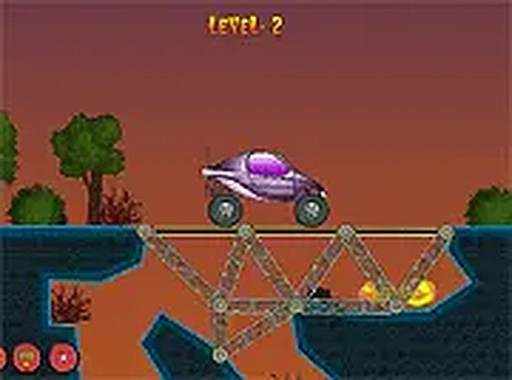
Every level in Structural Engineer Challenge hands you a gap and a train that needs to cross it. Materials differ in strength and weight, so the same design won't work twice. You place supports, beams, and spans, then run the train to see if your structure holds. When it fails, the weak points break first, showing exactly where your load distribution went wrong. That feedback loop is the core of the game.From Simple Spans to Complex Trusses
Early stages keep things minimal: short gaps, few materials, and room to experiment. As you progress, gaps widen and obstacles multiply. Later levels demand multi-span bridges with angled supports, and resources become limited enough that every piece matters. The difficulty curve stays gentle, gradually introducing tension, compression, and load balancing without explicit tutorials.Clean Visuals, Clear Feedback
The game uses bright colors and simple geometric shapes. Trains look like cartoon locomotives, and the environment includes trees, hills, and rivers that frame each puzzle without cluttering it. When a bridge collapses, the animation is playful rather than punishing. That light tone keeps the focus on problem-solving and makes the game approachable for younger players or classroom use.No Single Correct Answer
Most levels accept multiple solutions. Arch bridges, suspension designs, and hybrid approaches can all work if the physics hold up. Failed attempts are informative rather than frustrating, since the game shows you precisely where the structure gave way. This encourages iterative thinking and rewards players who analyze before they build. The result is a puzzle game that teaches resilience alongside engineering concepts.Editorial Notes
Compatibility
💻 Desktop | 📱 Mobile | 📟 Tablet
– All supported · Best with Chrome or Safari
Faq
Does Structural Engineer Challenge require any prior engineering knowledge?
No. The game introduces concepts like tension, compression, and load distribution through play rather than theory. Early levels use simple spans and few materials, letting you learn by watching what holds and what collapses. The feedback is visual and immediate, so you can adjust without needing a textbook.
Can I build the same type of bridge on every level?
Not effectively. As gaps widen and obstacles change, a design that worked earlier may fail. Later levels require multi-span bridges and angled supports, and limited resources force trade-offs. The game encourages experimenting with different structural approaches rather than repeating one solution.
Is Structural Engineer Challenge suitable for children?
Yes. The visual style is bright and cartoonish, and bridge collapses are shown in a non-graphic, almost playful way. There is no violence or harsh failure state. The trial-and-error structure also makes it useful for educational settings where mistakes are part of learning.
What happens when my bridge collapses?
The game highlights the weak points that broke first, giving you a clear picture of where the load distribution failed. You can then rebuild with adjusted supports or different materials. There is no penalty beyond having to try again, so experimentation feels low-risk.
How many levels does the game have?
The input does not specify a level count. What is clear is that the game progresses from simple spans with few materials to wider gaps and more complex obstacles. The difficulty curve is designed to feel natural, gradually pushing you to consider tension, compression, and load balancing.
Does the game have multiplayer or online features?
The provided information does not mention multiplayer, online play, or social features. It appears to be a single-player puzzle experience focused on building and testing structures at your own pace. Any additional modes are not described.








Comments
0 comments