
Reviews
Bellum.io succeeds by pairing simple clicker controls with layered territorial decisions. The real-time multiplayer format keeps matches unpredictable, while the puzzle element forces spatial planning. It's family-friendly and easy to learn, but the balance between expansion and defense provides genuine strategic tension. The main limitation is the lack of detail on map variety and match length, but the core loop is solid for players who enjoy competitive thinking.
About this game
Territory Control Meets Puzzle Logic
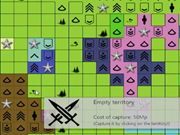
Bellum.io drops players onto a shared digital map where the goal is to claim neutral zones and protect what you've taken. The puzzle element comes from spatial reasoning: you must plan expansion routes, block opponents, and manage limited resources. Every match is a live contest, so no two sessions play the same. The game is designed for younger audiences, but the layered decision-making keeps veteran strategists invested.
Resource Generation and Expansion
Matches begin with simple actions—clicking or pressing a key—to generate resources. Those resources fuel two main choices: claim new territory or reinforce your base. Expanding too fast leaves you exposed; turtling stalls your growth. The tension between offense and defense is the core loop. As your territory grows, your base can be improved to boost resource output and defense, creating a feedback cycle that rewards careful pacing.
Reading the Map, Reading People
Because opponents adapt in real time, observation matters as much as speed. You'll watch for weak borders, overextended rivals, and opportunities to pivot. The puzzle layer asks you to solve logistical problems on the fly—how to route resources, where to fortify, when to strike. It's a game of calculated risks, and the best players think several moves ahead without losing reaction time.
Who It's For
Bellum.io suits players who enjoy competitive but family-friendly strategy. The clicker-style controls lower the barrier to entry, while the multiplayer environment ensures unpredictable challenges. Short sessions work, but extended play rewards those who refine their timing and decision-making. It's a rare mix: simple inputs, complex outcomes.
Editorial Notes
Compatibility
✅ Works on PC & Mobile | Recommended: Chrome / Safari / Edge
Faq
Is Bellum.io suitable for young children?
The game is designed to be easy to pick up and is tagged for kids. It features simple clicker-style controls and no graphic content. However, because it's multiplayer, children may encounter competitive behavior. Parental supervision is recommended for younger players.
Do I need to download anything to play Bellum.io?
Bellum.io is an online multiplayer game, typically played in a web browser. No download is mentioned in the available information. You'll need an internet connection to join matches with other players on the shared map.
How long does a typical match last?
Match length isn't specified, but the game supports both short sessions and extended play. Since matches are real-time and end when territory is decided, duration depends on player actions. You can likely play a quick round or stay for longer strategic sessions.
Can I play Bellum.io alone or is it only multiplayer?
Bellum.io is built around real-time multiplayer, where multiple players compete on a shared map. There is no mention of a single-player mode. The challenge comes from reacting to human opponents, so solo play isn't a supported feature based on the available information.
What skills do I need to do well in Bellum.io?
Success relies on efficient resource generation, spatial puzzle-solving, and adaptability. You'll need to balance expansion with defense, read opponents' moves, and make quick decisions. Practice improves reaction time and strategic foresight, but the simple controls mean anyone can start.
Are there different maps or scenarios in Bellum.io?
The game may include various maps or scenarios that alter the strategic landscape. This isn't confirmed in detail, but the core experience revolves around a shared digital map. Different layouts would change how you claim and hold territory, adding replayability.








Comments
0 comments