
Reviews
Neon Square Color Dodge succeeds because its rule set is tiny and its pressure is real. Watching your own ball's color while tracking hazards splits your attention in a way that most casual arcade games avoid, and the rising speed and denser patterns keep that tension alive. The neon look keeps the field readable. It is best suited to players who enjoy short, repeatable reaction challenges rather than anyone seeking depth, story, or variety beyond the core loop.
About this game
What You Actually Do
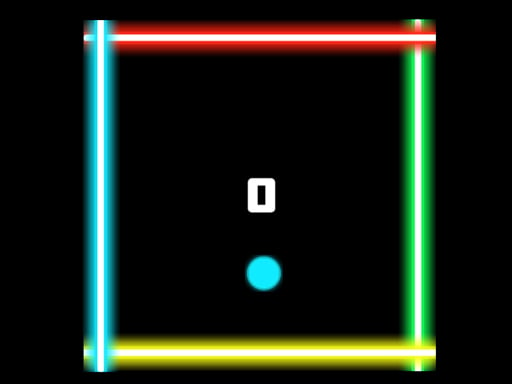
You move a ball around the inside of a bright neon square using a mouse or touch screen. The ball periodically changes color, and obstacles drift through the same space. The only losing condition is contact with an obstacle that shares the ball's current color. Obstacles of any other color are safe to touch or pass through. That single rule shapes every decision: you are not dodging everything, only the pieces that currently match you.
Why Color Tracking Is the Real Skill
Most reflex games ask you to watch moving objects. This one asks you to watch your own ball as closely as the hazards. Because the ball's color shifts without warning, a path that was safe a second ago can become lethal the moment your color changes. Players who fixate only on incoming obstacles tend to lose track of their own state. Splitting attention between the ball and the field is the core demand, and it is what separates a short run from a long one.
How Difficulty Escalates
Each cleared stretch earns points and pushes you forward. As you progress, movement speed rises and obstacle arrangements grow more intricate, so the same color-tracking skill gets tested under tighter timing. There is no separate difficulty menu described; the challenge curve is built into the run itself. That means early seconds feel manageable and later ones compress your reaction window, rewarding players who stay composed rather than those who move frantically.
Who Gets the Most Out of It
The controls are simple enough that no tutorial or prior experience is needed, which suits short breaks and quick sessions. Players interested in sharpening reaction time and visual focus will find a loop that invites repeat attempts, since each run is short and failure is easy to understand. The neon presentation keeps the playfield readable while still looking lively. Anyone expecting story, progression systems, or multiplayer will not find them here; the appeal is the single mechanic and the pressure it creates.
Editorial Notes
Compatibility
• OS: Windows 10+, macOS 11+, iOS 14+, Android 10+
• Browsers: Chrome 100+, Safari 15+, Edge 100+, Firefox 100+
• Not compatible with Internet Explorer
Tested on real devices ✅ works as expected
Faq
Do I lose if I touch any obstacle in Neon Square Color Dodge?
No. Only obstacles that match the ball's current color end your run. Obstacles in other colors are harmless, so you can move through them freely. This is the rule that defines the game, and misreading it is the most common early mistake.
Does Neon Square Color Dodge work on phones and tablets?
Yes. The game supports touch screen input as well as mouse control, so it runs on mobile devices and desktops alike. Dragging your finger moves the ball the same way moving the cursor does, which keeps the experience consistent across screen sizes.
Is there a way to pause or restart a run?
The supplied description does not mention pause or restart options, so this cannot be confirmed. What is clear is that a run ends the moment the ball contacts a matching-color obstacle, and clearing obstacles advances you to the next level.
How does the game get harder as I play?
Two things change together: the overall speed increases, and obstacle patterns become more complex. Neither is tied to a selectable difficulty setting. The escalation happens automatically within a session, so longer runs naturally demand faster recognition of your ball's color.
Is Neon Square Color Dodge suitable for young children?
The mechanic is easy to grasp and the visuals are abstract neon shapes rather than realistic imagery, which makes it approachable for a wide age range. Younger players may simply score lower until their color tracking and reaction speed improve with practice.
What is the best way to improve my score?
Keep your eyes on the ball's color rather than only on the obstacles, since your own color determines what is dangerous. Smooth, deliberate movement beats frantic dodging, and shorter practice sessions help build the habit before you attempt longer, faster runs.








Comments
0 comments